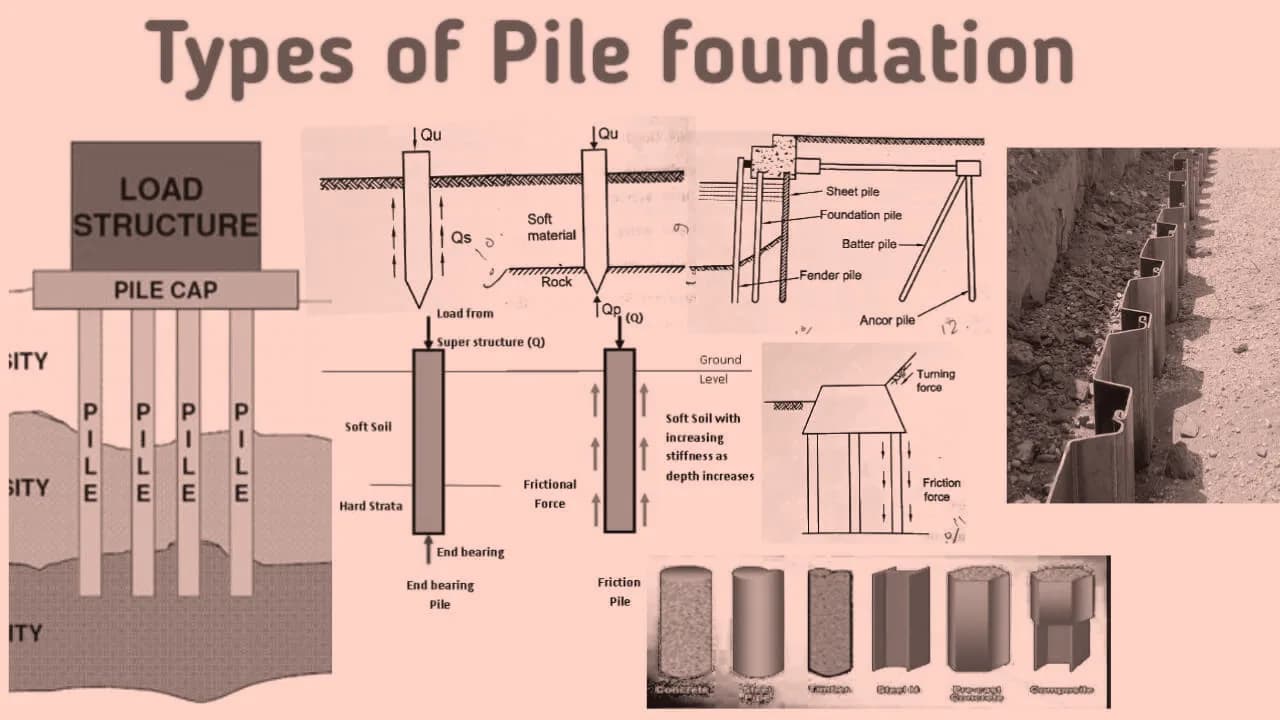
Soil composition forms the foundational premise for all engineering designs across industrial and logistics developments. When construction sites encounter fragile surface strata, soft clay, or non-homogeneous soil layers, traditional shallow foundations cannot sustain the heavy loads imposed by manufacturing lines and industrial machinery, posing severe risks of catastrophic settlement and structural failure. Geotechnical engineering provides calculated deep foundation solutions that safely transfer massive structural loads to deep, rigid rock or dense soil layers using advanced piling technologies.
Understanding the types of structural piles and their applications in supporting industrial buildings on weak soils encompasses all engineering techniques deployed to establish stable foundations over inadequate ground conditions. This detailed guide covers continuous flight auger (CFA) piling, hydraulic bored piling for heavy industrial installations, mechanics of end-bearing versus friction load transfer, practical field applications in factories and distribution hubs, and rigorous non-destructive testing protocols ensuring international safety compliance.
- Continuous Flight Auger (CFA) Cast-in-Situ Piles and Execution Methods
Continuous Flight Auger (CFA) piles represent one of the most widely implemented deep foundation innovations for modern industrial facilities and logistics parks:
- Drilling and Pressure Grouting Mechanics: A hollow-stem continuous flight auger rotates into the soil to the specified design depth. During gradual extraction, high-pressure reinforced concrete is pumped through the hollow shaft to completely fill the bore, preventing sidewall collapse.
- Environmental and Structural Advantages: CFA piling operates with minimal vibration and low noise levels, making it the ideal solution for working adjacent to existing structures or within active industrial complexes.
- Reinforcement Placement: Heavy steel cages are placed into the freshly grouted shaft immediately after concrete placement using specialized vibrators to guarantee central positioning and proper embedment.
- Deep Mechanical Bored Piling for Heavy Industrial Projects
When structural loads demand massive foundation diameters and depths extending dozens of meters into the ground, advanced hydraulic bored piling techniques are deployed:
- Bentonite Slurry Wall Stabilization: Synthetic polymer or bentonite clay slurry is continuously pumped into the borehole during rotary drilling to balance lateral earth pressures and prevent soil collapse prior to concreting.
- Tremie Pipe Concrete Placement: Concrete is placed through a submerged tremie pipe extending to the base of the borehole. Pouring proceeds from the bottom up, smoothly displacing the lighter drilling fluid without contaminating the structural concrete core.
- End-Bearing vs. Friction Piles in Structural Load Transfer
Selecting the optimal piling methodology depends on the geotechnical behavior of subsurface soil strata:
- End-Bearing Piles: Pass completely through weak upper soil strata until their bases rest firmly on deep bedrock or dense gravel layers, transferring the facility's total structural load directly to solid ground.
- Friction Piles: Deployed when bedrock lies at impractical depths; these piles transfer structural loads through skin friction developed along the rough interface between the pile shaft and surrounding cohesive clay or sand particles.
- Field Applications and Heavy Load Support in Industrial Facilities
Deep foundations serve various critical roles across large-scale industrial and commercial developments:
- Reciprocating Machine Foundations: Establishing rigid substructures that absorb dynamic mechanical oscillations and prevent vibration transfer to surrounding floor slabs and building elements.
- High-Bay Distribution Warehouses: Supporting extreme point loads beneath heavy steel racking systems and high-frequency forklift traffic without differential settlement.
- Pharmaceutical and Food Plants: Providing absolute structural stability to prevent micro-cracking in sterile cleanroom floor coatings and sensitive utility pipelines.
Geotechnical and Structural Excellence: Smart Construction Group (SCG) delivers turnkey geotechnical and deep foundation engineering solutions for major industrial and commercial projects. SCG's expert engineering teams strictly apply international building codes to safeguard structural investments and ensure long-term operational integrity.
- Field Quality Control and Pile Integrity Testing
Piling works undergo rigorous technical validation to confirm structural capacity and concrete integrity before superstructure erection begins:
- Static Load Testing: Subjecting completed test piles to hydraulic loads exceeding design capacity to measure immediate settlement and verify ultimate bearing resistance.
- Sonic Integrity Testing (SIT): Utilizing low-strain ultrasonic pulse waves to scan the pile shaft, verifying concrete homogeneity and ensuring freedom from necking, voids, or inclusions.
Summary and Strategic Engineering Value
Thoroughly analyzing the types of structural piles and their applications in supporting industrial buildings on weak soils turns unsuitable land into a rigid, reliable foundation platform. This protects industrial assets against settlement and cracking, guaranteeing uninterrupted operational performance over decades.